
 Law360 collects findings from the latest BTI Consulting Group Client Services A-Team report, which names the 63 most arrogant law firms on the block, categorizing them into three distinct tiers of arrogance…
…source…
Law360 collects findings from the latest BTI Consulting Group Client Services A-Team report, which names the 63 most arrogant law firms on the block, categorizing them into three distinct tiers of arrogance…
…source…
 After a long line of failed appeals Samsung has agreed to pay Apple $548 million in damages to Apple for patent infringement involving certain technology patents with its Galaxy smartphones, among others.
The $548 million damages figure stems from a US Court of Appeals for the Federal Circuit decision in May, which backed Apple and found that Samsung had infringed certain of Apple’s patents.
According to representations in court recently, the payment will be made on December 14, 2015.
However, Samsung has refused to cover $1.8 million in costs “because the Federal Circuit did not discuss costs in its opinion partially reversing the judgement, the costs award was vacated automatically,” Samsung said.
The full damages award of approximately $900 million, was reduced from more than the awarded $1 billion during a previous segment of the case, will also have to be reassessed, after the Federal Circuit vacated certain trade dress dilution findings, finding Apple’s rights to not be protectable.
Finally, the Patent Trial and Appeal Board has also invalidated one of the patents that Samsung was found to have infringed. Apple, however, is appealing against that decision.
…source…
 A copyright owner that files a “John Doe” infringement complaint but withdraws the case once the alleged infringer’s identity is revealed, without attempting to prove the accuracy of its claims, is not liable for attorneys’ fees, according to the US Court of Appeals for the Eighth Circuit.
Killer Joe Nevada, the owner of the rights to 2012 crime movie Killer Joe, dropped its copyright infringement complaint against defendant Leigh Leaverton after she was identified as the John Doe user of an IP address that had been associated with illegal downloads of the movie.
Leaverton (Defendant) rejected Killer Joe Nevada’s motion to dismiss the complaint, arguing that she should be awarded attorney’ fees because the lawsuit was unreasonable without an investigation into whether she had indeed infringed in the first place, stating:
Although this court has not reached that precise question, a plaintiff such as Killer Joe Nevada may properly sue “John Doe” to ascertain the ISP subscriber.
Leaverton cites no binding authority that a Copyright Act suit based on the infringer’s IP address is frivolous or unreasonable. The district court thus did not abuse its discretion by concluding that Killer Joe Nevada’s acts were reasonable.
…source…
 Working Americans spend almost a third of the workweek checking and reading email. In a 40-hour week, that’s over 11 hours a week reading online communications in fonts that aren’t doing our eyes any favors. Recent studies have considered the readability of fonts for business — including emails.
Having considered these options, I have changed my email font to a relatively new font called “Input”. A sample is below:
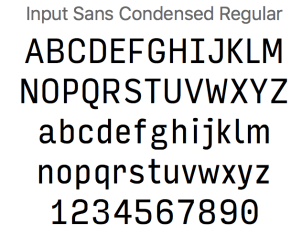
Hopefully, my clients will find email communications easier to read! You can download it – for free – here.
 This past Tuesday, the American Medical Association (“AMA”) called for a ban (in the U.S.) of direct-to-consumer (“DTC”) advertising of prescription pharmaceuticals and implantable medical devices.
The AMA cites its belief that DTC advertising contributes to the growing cost of pharmaceuticals in the United States.
According to Kantar Media, pharma companies spent $4.5 billion on consumer advertising in 2014, a 30% jump from 2012. According to IMS Health, spending on prescription medicines jumped 13 percent from 2013 to 2014 to $374 billion.
Presently, there are only two countries in the world that permit DTC advertising: the U.S. and New Zealand. The AMA is the latest health organization to call for a ban on such ads, following the World Health Organization, the National Center for Health Research and other organizations.
…source…
 Currently, the Mexican trademark system does not provide a method for third parties to oppose applications for potentially infringing third party marks.
The Mexican Senate is considering a bill that will introduce an opposition system for trademarks. Under the bill, any interested party can oppose an application within one month from the effective date of publication.
…source…
Further to our post here, Judge Sue Robinson of the US District Court for the District of Delaware issued a temporary order banning Dr. Reddy’s from selling its generic version of AstraZeneca’s Nexium, after the pharmaceutical company objected to its use of the colour purple.
Judge Robinson agreed with AstraZeneca, and held that Dr. Reddy’s capsule, “although not identical to AstraZeneca’s branded capsule, does fit the description of the mark, ‘purple’.”
…source…
In dismissing a lawsuit brought by an unknown R&B singer named Jesse Braham against Taylor Swift claiming copyright infringement, the judge referred to Swift’s lyrics.
Braham had claimed that the phrases “haters gonna hate” and “players gonna play” were plagiarized from his 2013 song “Haters Gonna Hate.” The judge concluded that the phrase “haters gonna hate” was already a meme and a popular item in Google searches before Braham’s song debuted. That’s to say nothing of the seminal 2000 track “Playas Gon’ Play” by 3LW, to which the judge also cites.
Her conclusion:
At present, the Court is not saying that Braham can never, ever, ever get his case back in court. But, for now, we have got problems, and the Court is not sure Braham can solve them. As currently drafted, the Complaint has a blank space— one that requires Braham to do more than write his name. And, upon consideration of the Court’s explanation in Part II, Braham may discover that mere pleading BandAids will not fix the bullet holes in his case. At least for the moment, Defendants have shaken off this lawsuit.
…source…
 L&G partner, Mathew Lombard, spoke last month at the Pharmaceutical Trade Marks Group (“PTMG”) last month on the topic of protection of trade and business secrets.
Although I was not able to attend the meeting this year, by all accounts, Matt’s presentation (along with his co-presenter, Barbara Kuchar) was excellent and well-received by the attendees.
We congratulate Matt for a successful presentation!
A copy of Matt’s presentation may be found here.
 Fox News anchor Harris Faulkner has filed a lawsuit against Hasbro. Faulkner wants the company to pay her $5 million because it made an inch-tall plastic toy hamster named “Harris Faulkner”.
Faulkner, a six-time Emmy winner who anchors “Fox News Weekend ,” filed suit against Hasbro in August for adding the hamster character to its line of “Pet Pawsabilities” toys. She claims that the hamster with a levitating butterfly hat “willfully and wrongfully appropriated Faulkner’s unique and valuable name and distinctive persona” for Hasbro’s financial gain.
In its motion to dismiss, Hasbro asserts, “a side-by-side comparison of Ms. Faulkner and the Hamster Toy shows that the two bear absolutely no resemblance.”
Hasbro further argues “[t]he Court should not accept Plaintiff’s opinion that the inch-tall hamster toy bears Ms. Faulkner’s resemblance, but instead must conduct its own comparison to determine whether the allegations are plausible as a matter of law.”
…source…
 Darren Geliebter
 Mathew Lombard
 THE PRINCIPAL REGISTER